Auto Theft Is Down — So Why Do Half of Ontario's Stolen Cars Never Come Home?
This week, Équité Association released its 2026 Canadian Auto Theft Impact Survey — and the findings are blunt. More than one-third of Canadians have now been personally affected by auto theft. Nearly two-thirds (64%) worry about becoming a victim. And only 18% believe the vehicles sold today can withstand modern, technology-based theft tactics.
Here's the strange part. That anxiety is peaking at the exact moment auto theft is falling. National auto theft is down 33% since 2023, and Équité's reporting shows theft dropped sharply in 2025: down roughly 25% in Quebec, 22% in Ontario, and 11% across Western Canada.
So why does nobody feel safer?
The regional numbers explain a lot. In Ontario, 40% of people have either been a victim of auto theft or know someone who has — rising to 47% in the GTA, 46% in Hamilton/Niagara, and a remarkable 61% in Peel Region. And 82% of thefts happen at or right next to the victim's home.
Maybe that's why Canadians have noticed the number that doesn't get the headlines: once a vehicle is stolen, the odds of getting it back are barely better than a coin flip.
What Is the Stolen Vehicle Recovery Rate in Canada?
According to Équité's most recent national report:
- Roughly 47,000 vehicles were reported stolen in Canada in 2025
- The national recovery rate sits at just 59%
- In Ontario and Quebec, only about half of stolen vehicles are ever recovered
- Alberta recovers about 71% — but continues to act as a "feeder province" where vehicles stolen elsewhere get re-registered
Theft prevention is improving. Recovery isn't. And that gap tells you something important about who is doing the stealing.
Where Do Unrecovered Stolen Cars in Canada Actually Go?
A joyrider abandons a car. An amateur gets caught. Organized crime doesn't do either.
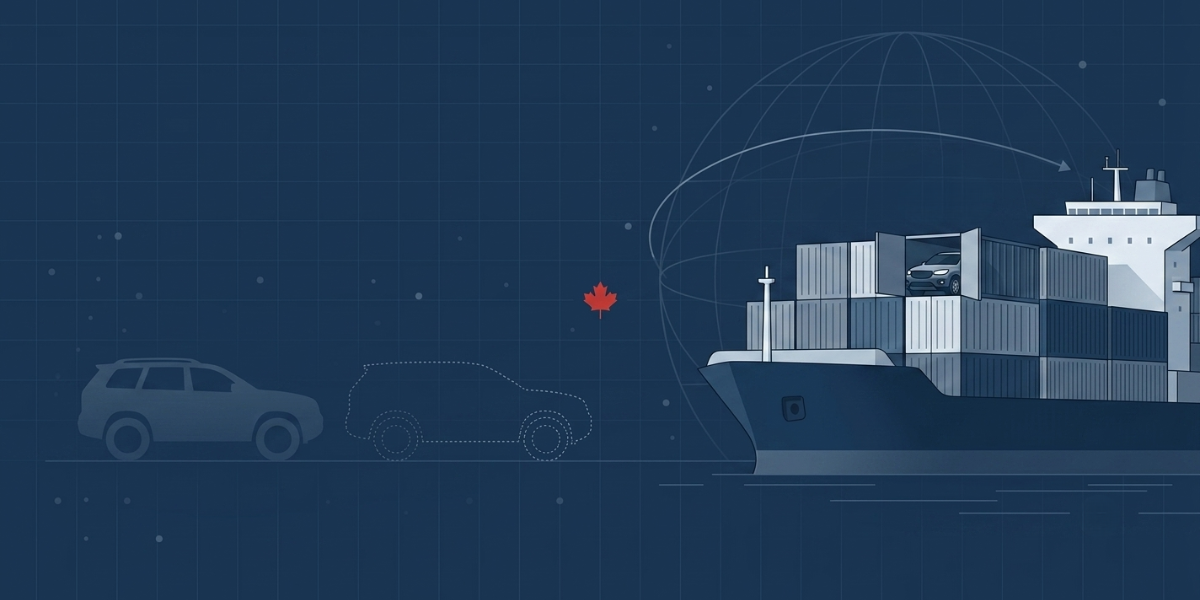
Équité's assessment is blunt: the vehicles that never come back have most likely been exported out of the country or broken down in chop shops. A vehicle in a shipping container at Montreal or Halifax isn't getting recovered by a patrol officer running plates — it's already gone. And Équité has also flagged a spike in vehicle finance fraud detected at those same ports, a reminder that theft, export, and financing schemes are increasingly the same criminal pipeline. (We explained how those export schemes are structured in What Is Grey Market Exporting of Vehicles — And Is It Legal? and What Is Parallel Exporting / Importing of Vehicles?.)
Bryan Gast, Équité's National Vice President of Intelligence & Investigations, put it plainly in the release: organized crime has moved past crowbars to relay attacks and key-fob reprogramming, and 72% of Canadians now say security protections should be built into vehicles rather than sold as after-market add-ons.
🎥 Watch: What happens after your car gets stolen?
Creator @danocracy traces the full pipeline — the relay attack in the driveway, why containers clear the border uninspected, and the vehicle surfacing on a used-car lot in West Africa.
Watch the full breakdown on Instagram →
A Reminder: 3 Ways Dealers Can Protect Themselves
The recovery gap isn't just a consumer story — dealerships sit at both ends of the theft pipeline. Vehicles get stolen from lots, and stolen or cloned vehicles get sold to them. Here's your refresher:
1. Protect your lot from theft.
With organized crime using relay attacks and key-fob reprogramming, a locked gate isn't enough. Store keys and fobs in signal-blocking cabinets away from the showroom, control after-hours access, and treat your most in-demand models as the targets they are. We covered the full playbook in How to Protect Your Dealership from Vehicle Theft.
2. Protect yourself from purchasing a cloned/stolen vehicle.
Run our 7-step cloned VIN checklist at every appraisal, and back it with an export-history check before you retail the trade.
3. Protect yourself from becoming part of the export pipeline.
Straw buyers and grey-market exporters source their vehicles from dealerships — and a buyer whose previous purchases keep turning up overseas is telling you something, if you have a way to see it. A properly written non-export agreement protects your allocation, your OEM relationship, and your paper trail.
The One Check That Closes the Gap
The common thread in every risk above is export history — the piece of a vehicle's story that traditional reports don't show.
A VINShield export check tells you in under a minute whether a VIN has left Canada, when, and where it went, drawing on more than 2.5 million exported VINs dating back to 2014. Run it at appraisal, before you retail a trade, and on repeat buyers whose deals feel a little too easy.
Auto theft may be trending down. The export pipeline isn't. Make sure the VIN in front of you still belongs to a car that's actually in Canada.
FAQ
What percentage of stolen cars are recovered in Canada?
About 59% nationally, according to Équité Association's latest report. In Ontario and Quebec, only about half of stolen vehicles are ever recovered; Alberta's recovery rate is roughly 71%.
Where do stolen cars from Canada end up?
The vehicles that are never recovered have most likely been exported through ports such as Montreal and Halifax or dismantled in chop shops, according to Équité Association.
Can a CPIC check tell me if a car was exported?
No. A CPIC stolen vehicle lookup flags vehicles reported stolen in Canada, but it has no record of export activity — and it can't detect a cloned VIN copied from a vehicle that has already left the country. Only an export-history check like VINShield's can show whether a VIN has left Canada.
Sources: Équité Association, "2026 Canadian Auto Theft Impact Survey" (Angus Reid Forum, 2,503 Canadian adults, June 1–8, 2026, ±1.8 pp at 95% confidence), released July 21, 2026; Équité Association auto theft trend report (February 2026), as reported by The Canadian Press.